Social anxiety: why online chat feels easier
Text removes the exact things social anxiety watches for. Here's how to use chat as practice rather than a hiding place, one rung at a time.
LustAI Editorial6 min read
This article is for general information and is not medical or psychological advice. If something here touches a hard place for you, talking to a professional is a good next step.
If typing to someone feels fine and talking to them feels like an exam, you're not imagining the gap. Text takes away the exact things social anxiety keeps watch over: your face, your voice, and the clock. Used one way, that relief becomes a training ground. Used another, it becomes the only room you'll enter.
Why is it easier to talk online with social anxiety?
Social anxiety, in the plain words the National Institute of Mental Health uses, is a strong fear of being watched and judged by other people. The fear pulls your attention inward. Instead of listening to the other person, part of you is monitoring your own cheeks, your own hands, and how long the silence has lasted.
Text quietly switches off most of that monitoring. Nobody can see you go red. A pause reads as "typing" rather than "frozen". You can read a message twice, think, and reply when you're ready. If it goes badly, you can leave without anyone watching you leave. The table shows what changes as you move from text to voice to video.
| What anxiety watches for | In text | In voice | On video |
|---|---|---|---|
| Visible signs (blushing, fidgeting) | Hidden | Hidden | Visible |
| The pause before you answer | Invisible | Audible | Audible and visible |
| Tone of voice | Absent | Present | Present |
| An audience for a mistake | Almost none | One person | One person, plus your own preview |
| Ability to leave quietly | Easy | Fairly easy | Awkward |
There's a second reason online talk feels lighter, and it applies to everyone, anxious or not. Being a little anonymous loosens people up; the piece on why anonymity makes conversations easier explains that mechanism. For someone with social anxiety, the loosening is simply bigger, because there was more tension to release.
Does online chatting help social anxiety or make it worse?
Both, and the research is fairly clear about when. A 2016 meta-analysis by Prizant-Passal, Shechner and Aderka pooled dozens of studies and found that people with higher social anxiety feel more comfortable online, prefer online conversation, and use the internet more for social reasons. So far, so reasonable. It's easier, so they go where it's easier.
The problem shows up in what the chat replaces. Weidman and colleagues (2012) found that socially anxious people who used online contact as a substitute for face-to-face life reported lower wellbeing than those who used it alongside it. Same amount of chatting, different role in the day, opposite result.
Psychologists have a name for the habits that make relief feel safe while keeping the fear alive: safety behaviours. Piccirillo, Taylor Dryman and Heimberg's 2016 review describes how rehearsing every sentence, avoiding eye contact, or planning an exit route all reduce anxiety in the moment and, over time, teach your brain that the situation really was dangerous. Online, safety behaviours look like this: drafting a message five times, deleting anything with a typo, never sending a voice note, and quietly closing any chat that asks to call.
None of that makes you a bad person. It just means the chat isn't doing the job you hoped. The fix is not to chat less. It's to let a little imperfection through.
How do you turn chat into practice instead of hiding?
The NHS lists cognitive behavioural therapy, which includes gradually facing feared situations, as the recommended treatment for social anxiety. The idea behind that "gradually" is simple enough to borrow without a therapist for the everyday stuff: you approach the thing you fear in steps small enough to finish, and you repeat each step until it feels boring rather than brave.
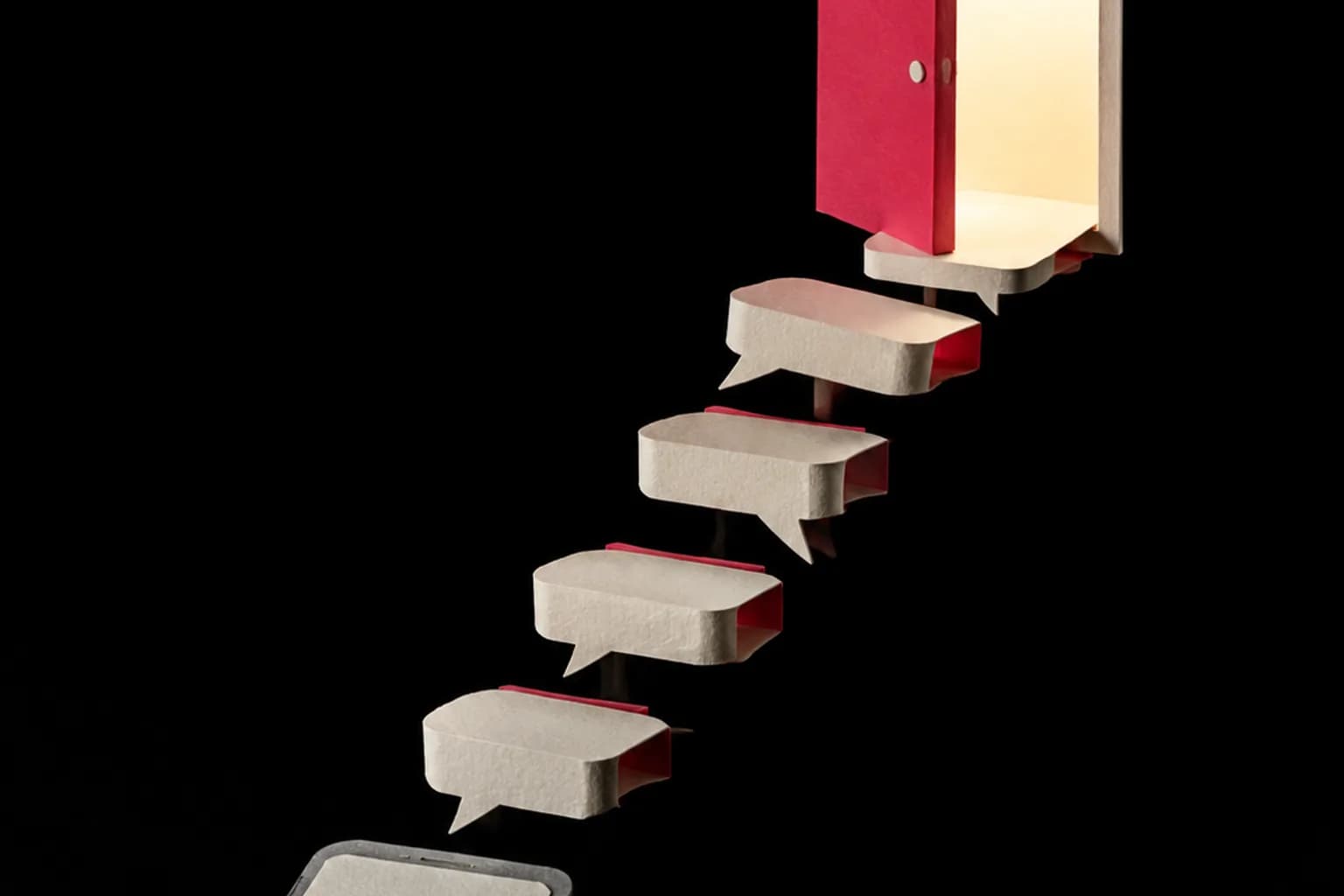
Chat gives you a ready-made ladder. The rungs below go from easiest to hardest for most people, though your order may differ, and that's fine. The rule is the same at every rung: stay on it until it's dull, then climb one.
- Text, with one imperfection. Have a normal conversation with someone new and send at least one message without re-reading it. If it has a typo, leave it there.
- Text, with a real opinion. Say something you actually think, even mildly: "Honestly I found that film boring." Notice that the other person survives.
- A voice note. Twenty seconds, one take, no re-recording. You could say: "Trying a voice note for once, sorry if it's rambly. Anyway, what were you saying about the trip?"
- A short voice call. Five minutes, with a reason to end it agreed up front: "I've got five minutes before I have to cook, want to just say hi properly?"
- Video, camera on, two minutes. Hide your own preview first. Give yourself one job, like asking the opening question, so your attention has somewhere to go that isn't your face.
- The same rung, again, with someone else. Repetition is the part people skip. One brave call teaches you nothing; five ordinary ones teach you it's ordinary.
What about video calls?
Video sits high on the ladder for a reason that has nothing to do with you personally. Stanford's Jeremy Bailenson argued in a 2021 paper on "nonverbal overload" that video calls hold faces unusually close and unusually still, make eye contact feel constant, and put a mirror of you on the screen the whole time. For anyone, that's a lot. For someone who already monitors their own face, it's the monitoring made visible.
Two changes take most of the sting out. Hide your self-view, so the mirror goes away. And sit back from the screen, so the other face is the size of a person across a table rather than a person leaning in. If the nerves before the call are the main problem, feeling nervous before a video call is normal and the piece has a short pre-call routine.
When it's not working
If you've been climbing for a few weeks and the same rung still feels like a cliff, that's information, not failure. Usually one of three things is going on: the rung is too big and needs splitting in half, you're using a safety behaviour on it (rehearsing, re-recording, an exit plan) that stops it from counting, or you're doing it once and calling it done. Halve the step, drop the crutch, repeat.
And if someone in a chat pushes you up the ladder faster than you agreed, such as insisting on a call you said no to, that's on them. You're allowed to say: "Not today, I'm keeping this to text for now." Anyone worth talking to will accept that the first time.
Not sure whether this is anxiety at all or just a quiet temperament? The difference between shyness and social anxiety is mostly about how much the fear costs you, and that piece has a gentle self-check. For a plan that treats conversation as a set of small reps, see building confidence one conversation at a time, and there's more in the wellbeing section.
When to get more help
If fear of being judged has been shaping your choices about work, study or friendships for six months or more, or if you're using alcohol or anything else to get through social situations, talk to a doctor; social anxiety is one of the most treatable conditions there is, and asking for help is itself a rung on the ladder.
Questions people ask
- Why is it easier to talk online when I have social anxiety?
- Because text takes away the signals anxiety scans for: a blush, a shaky voice, a pause that feels too long. You also get time to think and can leave without a scene. That relief is real; it is also why online chat can quietly become the only place you talk.
- Does online chatting help social anxiety?
- It can, if you use it the way a physiotherapist uses light weights: as a first step toward the thing you're avoiding. It doesn't help if you rehearse every line, delete anything imperfect and never move past text. Those habits keep the fear fed.
- Can chatting online make social anxiety worse?
- Yes, when it replaces offline contact rather than adding to it. Studies of socially anxious people find they feel more comfortable online, but the ones who lean on it as a substitute report lower wellbeing. The tool is fine; the direction matters.
- Can I practise social skills online?
- Yes, and it's one of the better uses of a stranger chat. Set one goal per conversation, such as asking a follow-up question or sending a voice note, and stop when you've done it. Practice works when it's a little uncomfortable and repeated, not when it's perfect.
- How do I get through a video call with social anxiety?
- Hide your own preview, sit back from the camera and give yourself a job, like asking the first question. Nerves before the call are normal even for people without anxiety. Keep the first video call short, and let the second one be a little longer.
Sources
- National Institute of Mental Health. Social anxiety disorder: what you need to know · NIMH
- NHS. Social anxiety (social phobia) · NHS
- Prizant-Passal, Shechner & Aderka (2016). Social anxiety and internet use: a meta-analysis · Computers in Human Behavior
- Weidman et al. (2012). Compensatory internet use among individuals higher in social anxiety and its implications for well-being · Personality and Individual Differences (PubMed)
- Piccirillo, Taylor Dryman & Heimberg (2016). Safety behaviors in adults with social anxiety: review and future directions · Behavior Therapy (PubMed)
- Bailenson (2021). Nonverbal overload: a theoretical argument for the causes of Zoom fatigue · Technology, Mind, and Behavior (APA)
Written by LustAI Editorial. We write plain-language guides about talking to people online, staying safe and feeling good about it. Every piece is researched against primary sources, edited by a human, and reviewed again whenever we update it.
Keep reading

Feelings & wellbeing
Shyness vs social anxiety: what's the difference?
Shyness, introversion and social anxiety can overlap. Compare what you want, what you fear and what gets in your way, without diagnosing yourself.
6 min read

Feelings & wellbeing
Building confidence one conversation at a time
Confidence in conversation is built with reps, not mindset. A five-chat plan with one small goal per chat, and the research on why it works.
5 min read

Meeting people online
Why anonymity makes it easier to open up
You told a stranger something you've never told a friend. Here's the psychology (disinhibition, the stranger on a train) and the one downside to watch.
6 min read